

Ally Han: Qufu “Where Everyone Is a Teacher”
When you arrive in Qufu, the hometown of Confucius, the first thing I notice is not the ancient architecture or the grand temples, but the way other people talk to me. On my first day in Qufu, I was a little confused by how people talked to us. Whether it was the staff at the scenic site, the volunteers inside the auditorium, or even the food delivery guy, who said: “Laoshi (Teacher), your delivery is here, please sign.” Me and my friends looked at each other and laughed: “Since when did we become teachers?” At first, it felt a little weird, almost funny. We were young adults from different countries, not actual teachers, but why were we being called that everywhere we went? After a few days, I began to understand. It wasn’t a mistake or just a polite term. It was something habitual here, but also rooted in culture and history. In Confucius’ hometown, “Laoshi” is not simply a job title. It is a way of showing respect, a recognition that every person has something to teach. Confucius once said: “三人行 必有我师焉 When three walk together, there must be one who can be my teacher.” In Qufu, I could truly feel the meaning of this. Here, everyone could teach, and everyone could learn.
Click here to read more about Ally's Fall 2025 trip to Qufu

Xia Seufert-White: Henan: Experiencing the “China Transition”
Flying past multistory shopping malls and office buildings made of glass, with names written in both English and Chinese characters, on an eight-lane highway, as the DiDi driver brought me from the Beijing Capital Airport to the PKU Global Village, is my first memory of being in China. Everything, from the platform I used to book the car, to the Alipay payment, completed with just a passcode, to the Teslas and other electric cars that shared the highway with us, to the skyscrapers just outside the window, seemed to me a tangible symbol of the transitions that have reshaped China over the past four decades.
Tianran Song: Hebei Trip
The morning air hung heavy with the scent of rain-soaked earth as we set out beneath a sky of muted gray. Our journey was long and winding—highways unfurling into mountain roads, which in turn narrowed into meandering country lanes. Outside the window, the world softened: steel and concrete fading into patchworks of farmland and scattered villages.
Three hours later, we arrived at our destination. The building, once a grain storage silo, still bore the rugged charm of its former life—weathered brick, rust-streaked beams—but inside, it had been thoughtfully repurposed. Now it housed offices for PKU volunteers and served as a gathering space for their charity efforts, complete with well-equipped event rooms and modest guest quarters. I was especially struck by the photo wall—a mosaic of smiling faces and handwritten notes left behind by past cohorts of CAPS students.
Click here to read more about Tianran Song's Spring 2025 trip to Hebei
Genevieve Moore: China’s New Development Paradigm at the Local Level
Visiting Hunan prompted me to reflect on the differences in how China is perceived by the Western world, versus how China perceives itself. China is oversimplified in the West, and discussions of China often focus solely on its development and “modernization,” or otherwise on political issues, at the cost of ignoring its long history and culture, which has played a crucial role in shaping the China that we see today. At the same time, the struggles that China has faced during its modernization, for example the development of a Chinese “nation,” are downplayed, which contributes towards an overly-simplistic view of China.
Click here to read more about Genevieve's Spring 2025 trip to Hunan
Serena Tang: Tianjin Field Trip Journal
This week’s field trip was more than just an all-inclusive trip to Tianjin, but a rare opportunity to experience the city through a historical and cultural lens. Very rarely am I so prepared and equipped with a whole lecture worth of knowledge when traveling to a new city. However, through the assigned readings, I was able to apply what we have learned in class directly to our field trip.
From Tianjin’s unique colonial architecture and historical significance, I could tell that Tianjin is very different from any other city in China. Prior to this class, I was not aware of how much western influence was in Tianjin. When we walked through the foreign concessions, I truly felt like I was walking through Europe. However, in some other parts of the city, I felt like the European style statues and architecture clashed with the modern style of Chinese buildings. As Professor Xu explained, there has been much criticism from Tianjin locals about some colonial influences such as the provocative European statues. While many of the colonial structures are now preserved as historical sites, their presence can feel like a lingering imprint of unequal power dynamics. Although I can appreciate the attempt to blend the East and the West, some parts of the city still feel incohesive even though there is the push to rebrand Tianjin as a “global city.” It still feels as if the city of Tianjin is still struggling to find its identity by reconciling its historical wounds with modern influence.
Click here to read more about Serena's Spring 2025 trip to Tianjin
Jodie Gao: Walking Through Time in Tianjin
Growing up, I was never particularly fond of history class or reading textbooks. I always felt distant from what I was learning. While history intrigued me, it seemed too abstract to relate to, too far removed from my own life to truly reflect on. It wasn’t until I arrived in Tianjin that I began to grasp how history can come alive, how it is woven into the fabric of modern life, and how it directly shapes the present.

As I stepped off the high-speed train from Beijing, I was struck by the significance of the moment. This wasn’t just any train—I was traveling on the very first high-speed rail built in China. I’d ridden highspeed trains several times this semester, but this journey felt different. It was as if I was riding the embodiment of China’s modernization, witnessing firsthand one of the country’s most iconic technological achievements.
Right from the station, I noticed the mix of Western-style architecture alongside traditional Chinese structures. It felt like I had landed in Europe, with this unusual fusion of cultures surrounding me. I was captivated by the European-style mansions and neoclassical buildings, and immediately realized that Tianjin’s history was far from simple.
Click here to read more about Jodie's Fall 2024 trip to Tianjin
Brenna Tosh: Guangzhou
Stepping into the conference hall for the Cornell in China forum was really surreal. I actually became immediately struck by emotion. What's funny is that I remember being really happy to see Cornell's shade of trademarked red. It was refreshing after being surrounded by a slighty different shade of red this semester all around. I felt like I had found home again. I think I've spent a lot of time this semester wishing that I could experience all that I am but on my beloved Ithaca campus, instead of fully accepting that this is my campus and this is my current country of residence. I have adapted and assimilated well to being here, but there will never be anything quite like suddenly being around people who are deeply connected with the campus you came from. So I might have actually taken away more non-academic reflections from the conference than grand academic ones.
Click here to read more about Brenna's Fall 2024 trip to Guangzhou
Emily Shen: Chengde
On the recent Cornell CAPS trip to Hebei province, we spent just one day in a small village called 虎什哈. We were only at the local school for four hours, two of which were spent with a seventh-grade class. Despite the brief time, the impact on us – especially in terms of the astonishment we felt – was immense, perhaps even greater than what the students might have felt based on their requests for our signatures. From the moment we arrived, through our time at the school, and later in conversations with 先老師, we encountered many different, and sometimes conflicting, aspects of middle school life in the village. What I initially thought would be a light-hearted cultural exchange turned into a deeper reflection on how we present the "best" version of ourselves.

On the first night when we had arrived at the village, 先老師and the other teachers of the program had kindly arranged for us to join them for a delicious hot pot dinner, during which I got my first “experience” of what the students at the local middle school were like. Since we were such a big group, hot pot had been divided into three different groups, and I somehow ended up in the local teacher group, where it was one me and the rest were all local teachers. Over the course of dinner, apart from only our group going through four large bowls of lamb meat (compared to the single bowls of the other two groups), then, we discussed various random topics ranging from what we had done earlier in the day to what they had recently harvested to the state of education in the village on three different levels.
Click here to read more about Emily's Fall 2024 trip to Chengdu.
Jacky Chen: Discovering Chongqing and Chengdu
Discovering Chongqing and Chengdu: A Journey of Culture and Connection

My first memory in Chongqing was our visit to Chongqing University, where we were warmly welcomed by fellow undergraduate, master’s, and PhD students. It was incredible to connect with peers from different parts of the world and immediately notice the cultural and societal differences. For example, the annual tuition at Chongqing University is around $900 USD, a stark contrast to the nearly $90,000 USD tuition in the United States. Exchanging letters and gifts with these students was a heartwarming experience that built meaningful connections. That evening, we dove into the famous Chongqing hotpot, a dish that's both fiery and numbing, giving us a genuine taste of local cuisine. Growing up in Flushing, New York—a place often compared to China—I’ve seen how Chinese migrants have shaped its urban landscape with vibrant food stands and tightly packed food shops, adding a lively and dynamic flair to the neighborhood.
Click here to read more about Jacky's Fall 2024 trip to Chongqing and Chengdu.
Jacqueline Cheng: Chengde
The rich culture and history of Chengde reflects the importance of Chinese history within a modern day context. Chengde, located in Hebei Province, China, is a city steeped in history, culture, and natural beauty. Its rich past intertwines with the rise and fall of dynasties, the forging of empires, and the evolution of Chinese civilization. Known historically as Rehe, named after the river that flows hot due to underground springs that feed it, Chengde holds a significant place in Chinese history, primarily due to its association with the Qing Dynasty and the construction of the magnificent Chengde Mountain Resort, a UNESCO World Heritage Site. In fact, the history of Chengde dates back over two millennia, with evidence of human habitation found as early as the Han Dynasty (206 BCE – 220 CE). However, it was during the Qing Dynasty (1644-1912) that Chengde became what we know it as today. In 1703, Emperor Kangxi of the Qing Dynasty decided to establish a summer residence in Chengde to escape the summer heat of Beijing and to consolidate the Qing Empire's control over the vast territories of northern China. This marked the beginning of Chengde's transformation into an imperial retreat and a center of political and cultural activity as a seat of the emperor’s political power.
Click here to read more about Jacqueline's Spring 2024 trip to Chengde.
Harlie Dultz: Anhui

When I was on the train to Anhui, I didn’t know what to expect. I wondered, what did a second-tier Chinese city mean? Before this trip, my perception of China, which I received from Beijing, was that it was a modern society with advanced technology and social structures.
Another question I was wondering was how come I have heard about my friends traveling to other second-tier Chinese cities such as Chengdu and Xian, meanwhile, I rarely heard about people traveling to Anhui. Although Anhui is looking to increase its tourism, Anhui
is also famous for its technology. I was excited to see a new part of China, a part of China that many foreign tourists do not travel to and a city that is not catered to them. This also means a new China that I can experience.
Click here to read more about Harlie's Spring 2024 trip to Anhui.
Feifei Hung: Tianjin
The trip to Tianjin has been a very eye-opening journey in shaping my understanding towards how China is currently shaping its inglorious history under Western and Japanese humiliation. Before the trip started, I only knew about Tianjin concessional history and how it is still preserved and vitalized when doing the class readings for CAPS 4003. I was very captivated by how Marinelle’s paper described Italian’s former concession in Tianjin as a “aristocratic concession”, carrying a underlying tone of intrusiveness and unwelcomeness, to a contemporary reinvention of “new Italian-style town” and Italianerie, in an accepting and embracing attitude. As she concluded that the intentions of China is to promote a harmonized image of Global China through the domestication of the foreign-Other while commodifying culture for highly economic capital, I became very curious to experience how she came to such conclusions of China’s strategic intentions in constructing a certain image. Could it be all strategic reasons? What are some cultural motivators behind?
Click here to read more about Feifei's Spring 2024 journey to Tianjin.
Ianna Ramdhany Correa: Yiwu “the world’s capital for small commodities”
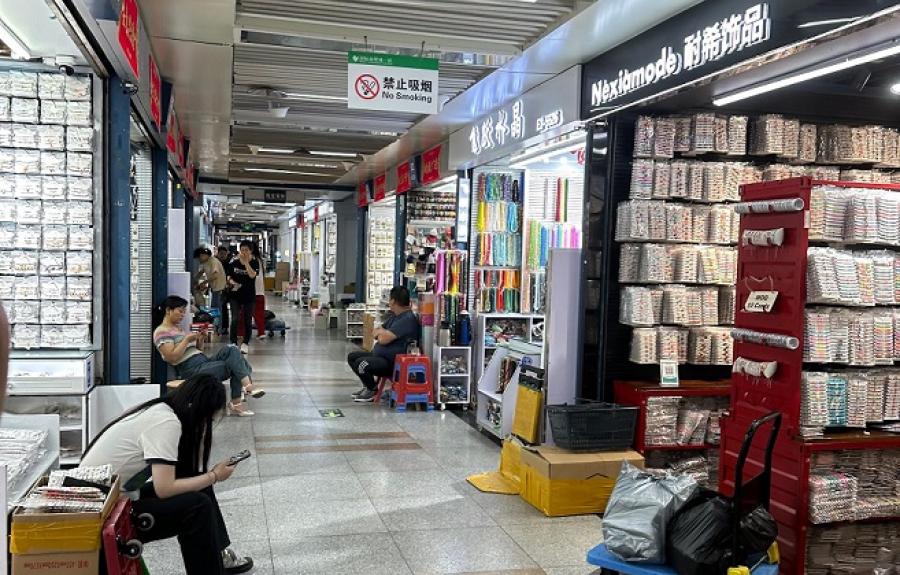
Of all the cities we traveled to within Zhejiang province, the one that was the most different from what I had imagined was Yiwu. Yiwu is known as “the world’s capital for small commodities” and boasts China’s largest wholesale market. Within this market, I was expecting to be the only foreigner around, as I had experienced in many of the places we had explored in Beijing. I quickly realized that I was greatly mistaken. At every twist and turn, I found other foreigners trying their hand at negotiating and buying in bulk, likely intending to resell in their respective countries.
Click here to read more about Ianna's Fall 2023 trip toYiwu.
Nicole Mah: Alibaba
In the first week of September, our journey led us to the province of 浙江, officially designated as the "共同富裕示范区" in May 2021. During our visit to Hangzhou, Yiwu, and Wenzhou, we explored a diverse array of companies, spanning genomics and e-commerce, smart home appliances and metal manufacturing. However, it was our insightful excursion to Alibaba that truly broadened my horizon.
Click here to read more about Nicole's Fall 2023 visit to Alibaba.
Eric Zhang: My journey across Zhejiang
Throughout my journey across Zhejiang, it was not the places I saw, but in fact the people I met that left the most significant impact.
My adventure began in Hangzhou, a city nestled on the shores of West Lake, known for its natural beauty and Alibaba's vibrant headquarters. I had the privilege of meeting with Carrie, who shared with me the inner workings of Alibaba, its unique company culture, and its unwavering mission. The passion she conveyed was infectious, and I left our conversation feeling deeply inspired. Alibaba's commitment to innovation and its dedication to making a positive impact on society left an indelible mark on me. I knew then that I wanted to be a part of this incredible journey once I completed my college education.
Click here to read more about Eric's Fall 2023 journey across Zhejiang.
Victoria Liu: Observations of Taoism and Chinese Consumerism

"Not only is Taoism politicized as a symbol of Chinese culture, but it has also been commercialized. Aside from the more traditional means of fortune-telling and blessing, Qingcheng Mountain has also expanded its service to an immersive experience of Taoism, allowing tourists to spend a night or so in Shangqing Palace. You do not to be a pious believer to experience the daily lives of Taoist priests (道⼠). Region is run as a business here."
Click here to read more about Victoria Liu's Fall 2019 trip to Chengdu.
Kate Selley: An Observation of China's Rebound

Click here to read more about Kate Selley's Spring 2019 trip to Tianjin and Binhai.
Kathy Wang: Empathetic Connections to China

Click here to read more about Kathy Wang's Fall 2017 trip to Gansu.
Joseph Evans: Exploring the Silk Road Today

Click here to read more about Joseph Evans' Fall 2017 trip to Gansu.
Wendy Chen: Camels, Caves, and Theater Without a Stage

Click here to read more about Wendy Chen's Fall 2017 trip to Gansu.